


 Humm by flexifi



Secure Checkout • Trusted Irish Music Store Since 1968
RCF Compact A 12 12-Inch Two-Way Passive Speaker
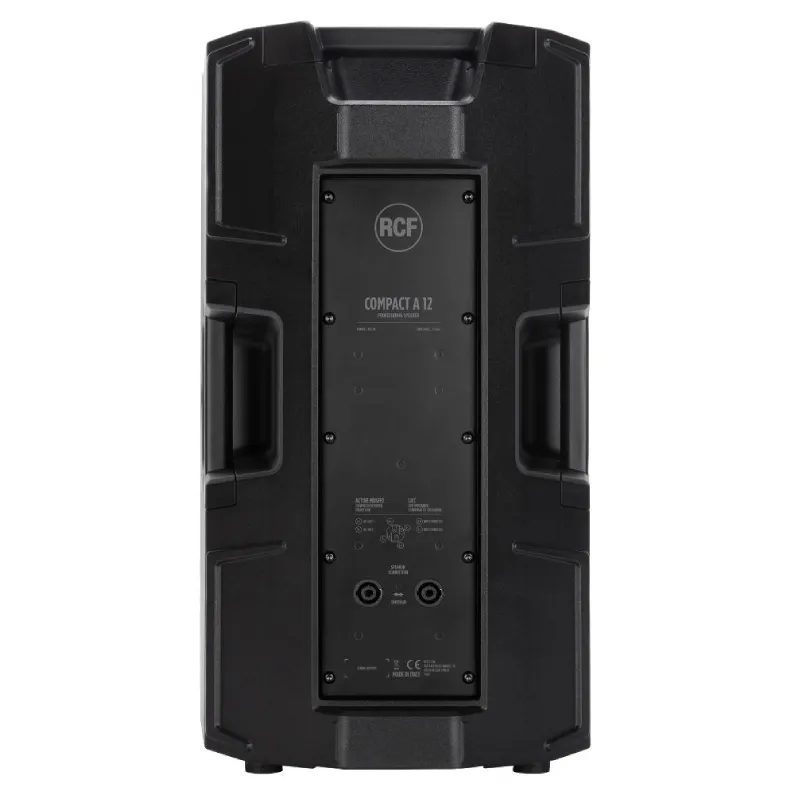
COMPACT A 12 is a multipurpose two-way full-range professional speaker system, suitable for a wide range of applications.
€699.00Free Delivery
In Stock in Ireland – Ships from our Drogheda Warehouse


One of the premium brands we are proud to represent.
RCF Compact A 12 12-Inch Two-Way Passive Speaker (400W RMS)
RCF Compact A 12 12-Inch Two-Way Passive Speaker. Deliver exceptional sound quality and high-output performance with the RCF Compact A 12 Passive Speaker. Combining a high-power 12″ woofer and a precision 1.75″ compression driver, this versatile two-way passive loudspeaker produces 400 W RMS power handling and reaches impressive peak output up to 129 dB SPL. Engineered by RCF in Italy, it offers dynamic vocal clarity, deep punchy bass, and consistent directivity across the entire venue.
Built for both demanding live sound environments and permanent venue installations, the Compact A 12 features a lightweight polypropylene composite cabinet reinforced with an internal M-brace to prevent cabinet resonance. Equipped with ergonomic carry handles, standard 35 mm pole mount sockets, and multiple M10 rigging points, it easily adapts for main PA use, floor monitoring, or suspended bracket mounting. Robust, reliable, and fitted with dual SpeakON input/output connectors, it’s a professional choice for gigging bands, DJs, and installers alike.
Key Features & Specifications of the RCF Compact A 12 12-Inch Two-Way Professional Speaker
- Power Handling: 400 W RMS / 1600 W Peak at 8 Ohms
- Maximum Output: Up to 129 dB Sound Pressure Level
- Frequency Response: 55 Hz – 20,000 Hz (-10 dB)
- Coverage Pattern: 100° x 60° constant directivity waveguide
- High-Frequency Driver: 1.0″ exit, 1.75″ voice coil compression driver
- Low-Frequency Driver: 12″ high-power woofer with 2.5″ voice coil
- Cabinet Design: Durable PP composite material with internal M-brace reinforcement
- Mounting & Rigging: Integrated 35 mm pole mount, top and side ergonomic handles, and M10 rigging points
- Connections: 2 x SpeakON I/O sockets
- Dimensions & Weight: 641.6 x 369.9 x 363 mm | 18.2 kg
RCF Compact A 12 12-Inch Two-Way Passive Speaker

Frequently Asked Questions: Active vs. Passive Speakers
What is the main difference between active and passive speakers?
The fundamental difference comes down to amplification:
- Active Speakers (Powered): Have built-in power amplifiers specifically tuned to the speaker drivers. They plug directly into a mains power outlet and take a line-level audio signal (from a mixer, audio interface, or phone).
- Passive Speakers (Unpowered): Do not have built-in amplifiers. They require an external power amplifier or powered mixer to drive them, connected via dedicated speaker cables (such as SpeakON or 1/4″ jack).
Which is easier to set up for live gigs or mobile DJs?
Active speakers are generally much faster and simpler to set up. Because the amplifier, crossover, and Digital Signal Processing (DSP) are built inside the cabinet, you simply plug in power and run a signal cable from your mixer. You don’t need to carry heavy external amplifier racks or worry about matching power ratings.
Are active speakers better than passive speakers?
Neither is inherently “better”—it depends on your specific application:
- Active Advantages: Perfectly matched internal amplifiers and crossovers designed by the manufacturer, built-in limiter protection, fewer components to transport, and plug-and-play simplicity.
- Passive Advantages: Lighter physical cabinets, easier central control (all amps kept in one rack), lower cost per speaker cabinet, and greater flexibility to upgrade or replace individual amplifiers and speakers separately.
What cables do I need for active vs. passive speakers?
- Active Speakers: Require a mains power cable (IEC/PowerCON) for electricity AND a signal cable (XLR or 1/4″ Jack) to receive audio from your source.
- Passive Speakers: Require only a single speaker cable (typically SpeakON or 1/4″ Jack) running from the external power amplifier to the speaker. No power cable is needed at the speaker itself.
Which option is best for venue installations (bars, churches, halls)?
Passive speakers are often preferred for permanent venue installations. Running speaker cable through walls and ceilings to high-mounted passive speakers is safer and easier than installing power sockets near every speaker location. Additionally, venue staff can control power and volume for all speakers from a single equipment rack in a secure control room.
What happens if a component fails during a performance?
- Active Speakers: If the internal amplifier fails, that individual speaker goes silent, but the rest of your PA system keeps working.
- Passive Speakers: If a main external amplifier fails, all speakers connected to that channel or amplifier will go silent. However, replacing a faulty rack amplifier on site is often faster than sending an active cabinet away for repair.
Summary: Which should I buy?
- Choose Active if: You are a gigging musician, solo performer, mobile DJ, or rental operator looking for a fast, portable, all-in-one setup with minimal gear to haul.
- Choose Passive if: You are installing a permanent audio system in a venue, already own power amplifiers, or prefer a centralized system where all controls and power are managed from one rack.
Only logged in customers who have purchased this product may leave a review.
Same Day Despatch*
Same Day Despatch T&C’s
Same day despatch is only available on orders placed Monday – Friday before noon. Orders placed on a Saturday & Sunday will be dispatched on Monday (except on a holiday weekend) Same Day Despatch is subject to stock and courier availability.
95% of our orders are delivered 1 day after Despatch date.
Please allow extra time at busy seasonal periods.*

Check out reviews on Trustpilot
I Haven’t received my order! Please tell us ASAP
If you haven’t received your order within 48 Hours please check the address and Eircode you gave at the time of purchase was correct, then contact us on 00353 419831078 ASAP so we can resolve the delivery issue ASAP.
Parcel tracking
Click here for more information on Delivery rights
Our delivery charges are generally less than an post, the chart below is for guidance.
An Post Domestic Delivery Rates (Feb 2026 – For Guidance Only)
| Weight not over | Letter/Postcard | Large Envelope | Packet | Parcel |
|---|---|---|---|---|
| 100g | €1.85 | €3.50 | €4.40 | €9.00 |
| 250g | €3.50 | €5.50 | €9.00 | |
| 500g | €3.50 | €7.00 | €9.00 | |
| 1kg | €9.00 | €9.00 | ||
| 2kg | €9.00 | €9.00 | ||
| 2.5kg | €11.00 | |||
| 5kg | €11.00 | |||
| 10kg | €13.00 | |||
| 20kg | €16.00 |
Returns Policy
Please read our Returns Policy carefully before ordering through our online store.
Cancellation before dispatch. Our aim is to package and dispatch the goods within 1 to 3 working days of receiving an order. If you wish to cancel an order within this time frame please contact us by email from our contact page. If the goods have not been dispatched then we will cancel your order and refund the invoice value. Confirmation of this refund will be email to you. For orders that have been dispatched please follow our returns policy. If you refuse to accept the delivery we will charge you for the return postage cost to us.
Returning Unwanted Goods In accordance with the Distance Selling legislation. We are happy for you to return unwanted goods within 14 days from date of delivery so long as they are returned in an unused new condition with the original packaging and all manuals and accessories, cables, PSU’s (if applicable), the original invoice and a completed returns form. Please note it is the customer’s responsibility to ensure the goods are returned safely to us and the customer must pay postage costs.
Upon receiving the return goods we will issue a refund to your credit card/method of payment for the invoice value. To obtain a return form contact us by email at info@soundshop.ie. Please note there is no refund or exchange on Books or Sheet Music due to Copyright! Returning Faulty Goods If you discover the goods you have purchased to be faulty upon receiving, please contact us at once by email so we can resolve the issue as quickly as possible. All goods sold are covered by the standard manufactures warranty against faulty materials or poor workmanship.
The manufactures warranty will not cover damage due to misuse, accidental damage, wear and tear. Faulty goods must be returned with proof of purchase and returns form. We will endeavour to resolve the issue upon receipt of the faulty goods by either replacing the product with a new or equivalent model or a refund for the original invoice value to your credit card/method of payment.
Returns Step by Step Process:
1: Inform us that you wish to return the goods and clearly state the type of return in the email i.e. Refund or Faulty. We will send you a returns form by email.
2: Complete the returns form and print a copy to go along with the returning goods and place inside the returning box.
3: If at all possible use the original delivery box or obtain a new box (at your own expense). We would ask you not to write, label or tape the retail packaging when returning unwanted purchases. If this happens, it will influence your refund claim.
4: Make sure to firmly pad the returning goods to avoid damage in transit
5: Tape the box securely and clearly mark our return address on the outside of the box. If you are using the original box, please make sure to remove or unmark your delivery address.
6: Organise shipping for the returning goods and retain a receipt from the courier company as proof of postage, as unfortunately we will not be able to accept responsibility for packages lost in transit.
Return Address:
The Sound Shop, 11 East coast Business Park Matthews Lane, Drogheda. A92 XV26 Phone: (00)353 (0)41-9831078 FAX: (00)353 (0) 41-6849906 Should you need to contact us directly please email us at info@soundshop.ie
About Us
About the Sound Shop Drogheda (Ireland Ltd.) Est. 1968
The Sound Shop was established in 1968 by Tommy Leddy and Sean McEvoy, Tommy and Sean had being hiring PA equipment for some time from their homes and seeing there was a gap in the market for musical equipment and instruments they went on to open their first shop in 14 North Quay Drogheda, and so the Sound Shop was born.
The business grew quickly so it wasn’t long before a much larger premises was needed and just a few doors away from the original shop stood Mayoralty House a historic building with charm that became the home of music in Ireland for the next 37 years, With the success of the business and rise in popularity of out of town shopping the Sound Shop needed to be part of this movement so the decision was made to finally leave North Quay and built a brand new 12,000 sq ft mega store along with a 900 seat theater the TLT where both business still reside today 2023.
Ireland’s Favourite Music Store! The Sound Shop in Drogheda Co. Louth has been supplying musicians, both beginners and professionals from all over Ireland for more than 57 years. Come visit our 12,000 sq ft mega store, Ireland’s biggest and best!!

Customer Reviews
Read what our customers say about us on Trustpilot:

Active Powered Speakers The RCF EVOX J9 delivers an impressive 130 dB Max SPL output. Active Powered Speakers EVOX JMIX9 delivers professional performance across the entire signal chain. PA Cases & Covers CVR 60767 PADDED COVER for Evox J9 JMIX9 J11 Sub. Speaker Stands RCF PMK60768 Pole Mount KIT. Adjustable Mounting for EVOX Systems. PA Cases & Covers PA Cases & Covers Speaker Stands RCF VBR60682 Vertical Bracket – Professional Mounting Solution for RCF Speakers Active Powered Speakers The SUB 18-AX is more than just a subwoofer—it’s a complete speaker management system. Active Powered Speakers The RCF EVOX J11 delivers an impressive 132 dB Max SPL output. PA Cases & Covers Protect your RCF EVOX V15 with the official CVR60758 padded cover. 600D polyester, 10mm padding, zip & velcro closures, and handle access.Related Products
-16%New  Original price was: €1,539.00.€1,299.00Current price is: €1,299.00.Free Delivery-14%NEW for 2026
  Original price was: €1,975.00.€1,699.00Current price is: €1,699.00.Free Delivery-10%
  Original price was: €83.00.€75.01Current price is: €75.01.Free Delivery-8%
  Original price was: €119.90.€110.00Current price is: €110.00.Free Delivery-9%
  Original price was: €87.00.€79.00Current price is: €79.00.Free Delivery
RCF Protective Cover for NXL 14-A (CVR60685) – Durable, Padded, and Road-Ready.
-11%  Original price was: €129.00.€115.01Current price is: €115.01.Free Delivery
RCF CVR004 Padded Protection Cover – Heavy-Duty Weatherproof Cover for 705AS MK3 & 905AS MK3.
-11%  Original price was: €145.00.€129.00Current price is: €129.00.Free Delivery-14%
  Original price was: €2,089.00.€1,799.00Current price is: €1,799.00.Free Delivery-14%
  Original price was: €1,975.00.€1,699.00Current price is: €1,699.00.Free Delivery
  €138.99Free Delivery


Reviews
There are no reviews yet.