


 Humm by flexifi


Secure Checkout • Trusted Irish Music Store Since 1968
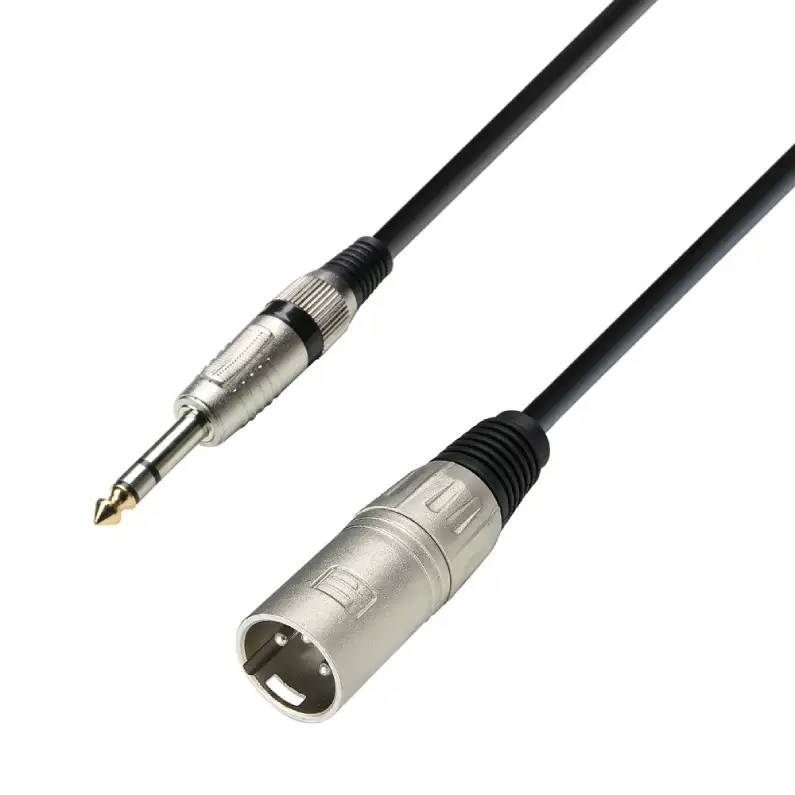
Adam Hall K3BMV0300 Balanced Cable XLR male to Jack TRS | 3 m
Balanced Cable XLR male to Jack
€9.90
In Stock in Ireland – Ships from our Drogheda Warehouse


One of the premium brands we are proud to represent.
Adam Hall K3BMV0300 Balanced Cable XLR male to Jack TRS | 3 m
Adam Hall K3BMV0300 Balanced Cable XLR male to Jack TRS | 3 m. Counterpart of the K3BFV microphone cable, balanced conductor routing, this time with a 6.3 millimetre TRS plug and a male XLR plug. Uses original Adam Hall plugs and high-quality cable material.
General
Cable length: 3 m
Cable jacket: PVC
Cable diameter: 6 mm
Cable colour: Black
A “Balanced Cable XLR male to Jack” is an audio cable that’s commonly used in professional audio and music settings to transmit balanced audio signals. Here’s what this cable configuration typically involves:
- XLR Male Connector: One end of the cable features an XLR male connector. The XLR connector is a three-pin connection used for balanced audio signals. It’s often found on microphones, professional audio equipment, and soundboards.
- Jack Connector: The other end of the cable terminates with a Jack connector. The Jack connector can come in various sizes, with the most common being 1/4-inch (6.35mm) TRS (Tip-Ring-Sleeve) or TS (Tip-Sleeve) connectors. Jack connectors are often used for instruments, amplifiers, and some audio interfaces.
- Balanced Audio: This cable configuration is used to carry balanced audio signals. Balanced audio signals are designed to minimize interference and noise, making them ideal for long cable runs in professional audio applications. The XLR connector is well-suited for balanced signals because it offers separate conductors for the audio’s positive and negative phases, as well as a ground connection.
- Applications: You would typically use a “Balanced Cable XLR male to Jack” to connect a device with an XLR output, such as a microphone, to another device with a Jack input, like a mixing console or an amplifier. This cable allows you to maintain a clean and noise-free audio connection over longer distances.
- Usage: When connecting the cable, the XLR male end goes into the XLR output on the source device (e.g., a microphone), and the Jack connector is plugged into the Jack input on the receiving device (e.g., a mixer or an amplifier).
- Professional Audio: These cables are commonly used in live sound reinforcement, recording studios, and other professional audio settings where signal quality and interference rejection are critical.
- Cable Length: The length of the cable can vary based on your specific needs, and it’s important to choose an appropriate length to reach between your devices without unnecessary slack.
Adam Hall K3BMV0300 Balanced Cable XLR male to Jack TRS | 3 m
Same Day Despatch*
Same Day Despatch T&C’s
Same day despatch is only available on orders placed Monday – Friday before noon. Orders placed on a Saturday & Sunday will be dispatched on Monday (except on a holiday weekend) Same Day Despatch is subject to stock and courier availability.
95% of our orders are delivered 1 day after Despatch date.
Please allow extra time at busy seasonal periods.*

Check out reviews on Trustpilot
I Haven’t received my order! Please tell us ASAP
If you haven’t received your order within 48 Hours please check the address and Eircode you gave at the time of purchase was correct, then contact us on 00353 419831078 ASAP so we can resolve the delivery issue ASAP.
Parcel tracking
Click here for more information on Delivery rights
Our delivery charges are generally less than an post, the chart below is for guidance.
An Post Domestic Delivery Rates (Feb 2026 – For Guidance Only)
| Weight not over | Letter/Postcard | Large Envelope | Packet | Parcel |
|---|---|---|---|---|
| 100g | €1.85 | €3.50 | €4.40 | €9.00 |
| 250g | €3.50 | €5.50 | €9.00 | |
| 500g | €3.50 | €7.00 | €9.00 | |
| 1kg | €9.00 | €9.00 | ||
| 2kg | €9.00 | €9.00 | ||
| 2.5kg | €11.00 | |||
| 5kg | €11.00 | |||
| 10kg | €13.00 | |||
| 20kg | €16.00 |
Returns Policy
Please read our Returns Policy carefully before ordering through our online store.
Cancellation before dispatch. Our aim is to package and dispatch the goods within 1 to 3 working days of receiving an order. If you wish to cancel an order within this time frame please contact us by email from our contact page. If the goods have not been dispatched then we will cancel your order and refund the invoice value. Confirmation of this refund will be email to you. For orders that have been dispatched please follow our returns policy. If you refuse to accept the delivery we will charge you for the return postage cost to us.
Returning Unwanted Goods In accordance with the Distance Selling legislation. We are happy for you to return unwanted goods within 14 days from date of delivery so long as they are returned in an unused new condition with the original packaging and all manuals and accessories, cables, PSU’s (if applicable), the original invoice and a completed returns form. Please note it is the customer’s responsibility to ensure the goods are returned safely to us and the customer must pay postage costs.
Upon receiving the return goods we will issue a refund to your credit card/method of payment for the invoice value. To obtain a return form contact us by email at info@soundshop.ie. Please note there is no refund or exchange on Books or Sheet Music due to Copyright! Returning Faulty Goods If you discover the goods you have purchased to be faulty upon receiving, please contact us at once by email so we can resolve the issue as quickly as possible. All goods sold are covered by the standard manufactures warranty against faulty materials or poor workmanship.
The manufactures warranty will not cover damage due to misuse, accidental damage, wear and tear. Faulty goods must be returned with proof of purchase and returns form. We will endeavour to resolve the issue upon receipt of the faulty goods by either replacing the product with a new or equivalent model or a refund for the original invoice value to your credit card/method of payment.
Returns Step by Step Process:
1: Inform us that you wish to return the goods and clearly state the type of return in the email i.e. Refund or Faulty. We will send you a returns form by email.
2: Complete the returns form and print a copy to go along with the returning goods and place inside the returning box.
3: If at all possible use the original delivery box or obtain a new box (at your own expense). We would ask you not to write, label or tape the retail packaging when returning unwanted purchases. If this happens, it will influence your refund claim.
4: Make sure to firmly pad the returning goods to avoid damage in transit
5: Tape the box securely and clearly mark our return address on the outside of the box. If you are using the original box, please make sure to remove or unmark your delivery address.
6: Organise shipping for the returning goods and retain a receipt from the courier company as proof of postage, as unfortunately we will not be able to accept responsibility for packages lost in transit.
Return Address:
The Sound Shop, 11 East coast Business Park Matthews Lane, Drogheda. A92 XV26 Phone: (00)353 (0)41-9831078 FAX: (00)353 (0) 41-6849906 Should you need to contact us directly please email us at info@soundshop.ie
About Us
About the Sound Shop Drogheda (Ireland Ltd.) Est. 1968
The Sound Shop was established in 1968 by Tommy Leddy and Sean McEvoy, Tommy and Sean had being hiring PA equipment for some time from their homes and seeing there was a gap in the market for musical equipment and instruments they went on to open their first shop in 14 North Quay Drogheda, and so the Sound Shop was born.
The business grew quickly so it wasn’t long before a much larger premises was needed and just a few doors away from the original shop stood Mayoralty House a historic building with charm that became the home of music in Ireland for the next 37 years, With the success of the business and rise in popularity of out of town shopping the Sound Shop needed to be part of this movement so the decision was made to finally leave North Quay and built a brand new 12,000 sq ft mega store along with a 900 seat theater the TLT where both business still reside today 2023.
Ireland’s Favourite Music Store! The Sound Shop in Drogheda Co. Louth has been supplying musicians, both beginners and professionals from all over Ireland for more than 57 years. Come visit our 12,000 sq ft mega store, Ireland’s biggest and best!!

Customer Reviews
Read what our customers say about us on Trustpilot:

About Adam Hall
Adam Hall
Adam Hall. In 1975, Mr Adam Hall founded Adam Hall Ltd. in the English city of Southend-on-Sea (near London) as a manufacturer of high-quality, robust flight case fittings. Today, more than 45 years later, Adam Hall Group has developed into a global manufacturer and distributer, with comprehensive solutions for the event technology industry. Since then, numerous new brands have been developed and created at the current company location in Neu-Anspach, Hesse, Germany. As an international distribution company and service provider for more than 30 well-known brands, Adam Hall Group has been impressing its customers and business partners with its strong and sustainable concepts for decades. For the innovative and diverse event industry.
Distribution brands perfectly supplement our range, and present a wide product range for sound technicians, case manufacturers and retailers. Whether professional speaker chassis or plug connector, casters, rivets or adhesive tape, Adam Hall Group distribution brands offer solutions for both tailor-made projects and everyday tasks.
Our successful, cutting-edge own brands offer innovative and sophisticated products with pioneering features. Manufactured under the strictest quality controls, the brands and products by Adam Hall Group have outstanding professional functions in all fields of application, are highly reliable, and are designed to last.
Cameo | Defender | Gravity | LD Systems | Palmer | Adam Hall
Instrument Cables Patch Cables Instrument Cables Instrument Cables Instrument Cables Instrument Cables Superior Construction for Unmatched Performance. Speaker Cables Instrument Cables Instrument Cables Instrument Cables Adam Hall FLIPJACK® 5 Star 3M Instrument Cable | Palmer® Adam Hall FLIPJACK® straight and angled jack | 3 mRelated Products
 €9.50
Whether you're on stage, in the rehearsal room, or in the studio, this cable is the right choice.
-10%  Price range: €9.50 through €9.95
DAP cables deliver reliability, clarity, and an unbeatable value.
This product has multiple variants. The options may be chosen on the product page  €9.90
The perfect balance of price and performance.
 €8.00
STAGG 3M/10FT Vintage Tweed Cable is a durable, high-quality instrument cable.
 €10.50
STAGG SGC6PL Angled Jack Instrument Cable: Reliable and Versatile.
 €39.00
 €51.00
Padded organiser bag for cables and accessories.
 €39.00
he Adam Hall K5IPP0300SILENT Silent Instrument Cable is a premium 3-meter cable.
 €45.01
he Adam Hall K5IPR0600SILENT Silent Instrument Cable is a premium 3-meter cable.
 €35.01


